

Uwe Lausen
Stuttgart
1941 -
Beilstein
1970
Born in Stuttgart in 1941, Uwe Lausen began teaching himself to paint watercolors and do woodcuttings while still at school, showing a gift for composition at an early age. After graduating from secondary school, Uwe Lausen enrolled at Tübingen University to study law and philosophy, but soon dropped out to devote himself to art.
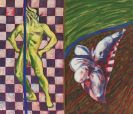
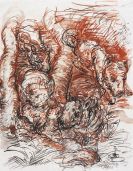
At nineteen, the artist moved to Munich, where he painted and produced prints, influenced by the "SPUR" group. Then Abstract Expressionism and Art Brut became the prevailing influences on his work. During the 1960s he followed the ideas of Nouveau Réalisme, discovering collage as an artistic means of expression, which he incorporated in wallpaper, photos and pictures from print media. At the same time he produced Surrealist landscapes with fragmented bodies and large monochrome color field paintings.
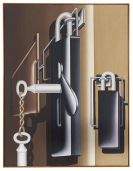
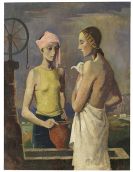
Between 1966 and 1969 his works were dominated by a realistic style of painting, which combines Pop Art and Hyperrealism with psychologically destructive imagery. These paintings reflect the social reality of the sixties in a highly sensitive manner. Uwe Lausen's late motifs mostly stemmed from the subculture with political overtones, the drug scene and a criminal environment and depict the world in an analytical, direct and often brutal manner.
Uwe Lausen had become a successful artist in the Federal Republic of Germany at an early age, holding exhibitions in Stuttgart, Munich, Paris and Berlin.
In 1969 Uwe Lausen left Munich for Switzerland, where he committed suicide in 1970.

Would you like to sell a work by Uwe Lausen?
Infos for seller


Starting bid: 5,000 EUR